
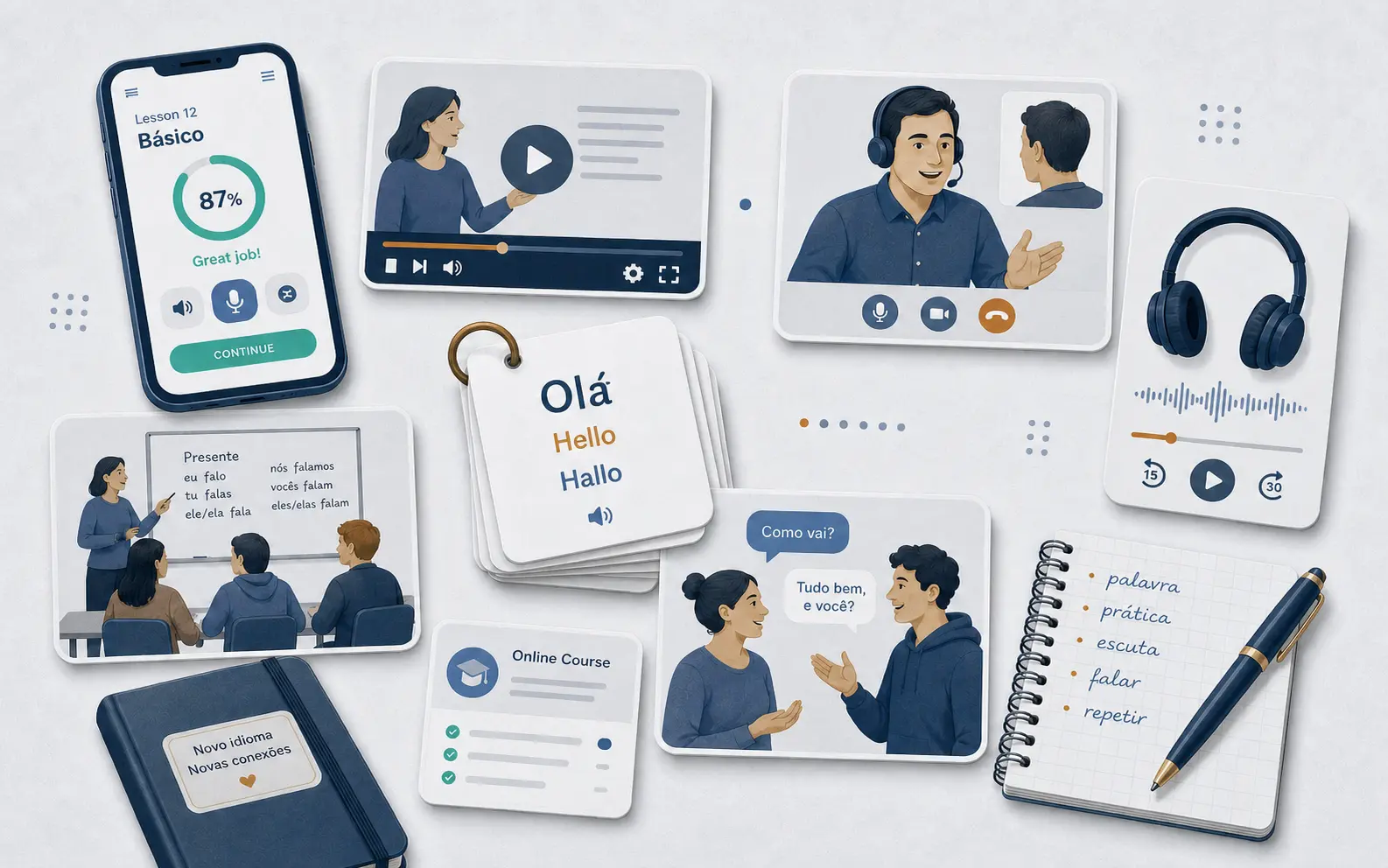
My favorite tools for learning a new language
I'm definitely not a good language learner. Even my English is far from perfect, although I need it at work and prefer to watch movies or read books in the original language whenever possible. I can communicate, write technical content, and understand basically everything. Still, speaking definitely doesn't feel as easy as in my native language.
Nevertheless, learning languages became a small hobby for me over the past few years. I started with Spanish and continued until A2 level, but then switched to Portuguese because my girlfriend is Brazilian. I want to learn her mother tongue and be able to communicate properly with her non-German friends and family. Besides that, it is challenging, a nice change from other daily routines, and very rewarding once you make some progress.
Below I want to highlight a few methods and tools you can use for learning a language and share my experience with each.
On-site classes
I started learning Spanish in a VHS course ("Volkshochschule"). It gives you some variety during the normal work week. You go somewhere, meet new people, and focus on the topic just like in school. A teacher guides the small group, explains grammar, and corrects pronunciation. It is probably not the most efficient method if you compare time spent with how much you learn. You progress slowly with the average speed of the group.
Still, I can recommend it to people who don't want to learn as efficiently as possible on their own and prefer to include a nice event during the week while learning a language.
Online courses
Recorded online courses are great when you like school-like learning with a tutor explaining grammar in a structured way, but want to progress at your own pace. I used Coursera, but the same probably applies to other platforms or good free YouTube courses.
What I like is that you can repeat lessons whenever needed. I did a Portuguese course which has around 50 hours of learning material, runs on mobile devices, and is structured into small explanation and practice units that fit well into my day.
For me, learning grammar through rules is important because I want to understand why we say things in a certain way. Just adapting automatically while reading and listening doesn't work that well for me.
Duolingo
I've used Duolingo for more than two years now and currently have a streak of more than 750 days. I know that a lot of people say they haven't learned anything while using Duolingo for months, but for me it works well. It's a daily habit that keeps me in contact with the language. I don't just do a single session to extend my streak. I spend around 15 minutes on average, which makes a huge difference in learning time over the years.
I also have to say that Duolingo became much better over the last few months. The stories, listening dialogs, writing exercises, and video calls are getting more useful. They force me to use the language much more on my own instead of clicking on the right words in the right order. I think adding AI to the app provides real value for the user.
Vocabulary cards
Learning vocabulary is key to progressing fast. The more words you know, the better you can understand content like podcasts and books. The better you understand content, the more you listen to it in that language, and the easier it gets. I used a lot of handwritten vocabulary cards in the beginning. This is great when you want an alternative to increasing your already high screen time. As an app, I use Quizlet. I like generating vocabulary packages that help me understand a specific topic in podcasts and then learning them. Quizlet can also speak the word for you, so you hear it with correct pronunciation.
LLMs for simple stories and summaries
At the very beginning of learning Portuguese, I liked creating stories and news summaries with an LLM at A1 Portuguese level. In the past, you probably would have bought one of the few beginner novels about topics you aren't interested in. Today, you can use tokens to create your favorite stories and updates in simple language. By now, I regularly watch some of my favorite Brazilian YouTube channels, which I describe below.
YouTube and podcasts
Switching to real content is overwhelming in the beginning. I think it's worth starting early, even if you only understand some words. Pick topics you like and already know a bit about, and maybe prepare yourself with a vocabulary list as described above. Don't try to understand everything. Slow down the playback speed and try to follow a few minutes with high concentration. Then just let the language run in the background. I believe this helps a lot without consuming too much of your capacity. Your brain gets used to the rhythm of the language and typical sentence patterns. Over time, it gets easier to catch the context and even some details, which is very rewarding.
Online tutors
Although Duolingo is getting better at making you speak your own thoughts, the number of words I speak in the app is still very limited. If you don't have friends who are native speakers, there are some online solutions for talking to native speakers. One solution I want to highlight is using a personal tutor. Preply is a platform you can use for that. For Spanish and Portuguese, especially with tutors from Latin America, prices can be quite affordable from a European perspective for a one-to-one lesson.
Final thoughts
Learning a new language seems to be a bit of a trend right now. Or maybe I'm just in that bubble. From Duolingo statistics we know that half of their users are learning English. From a global perspective, this is a demand to participate socially and economically. The other half of the users are learning other languages, and probably many of them are learning as a hobby.
We use AI and tools for so many shortcuts now. Learning a language is the opposite in a good way. It's brain exercise we actively choose to compensate for the tool-based shortcuts we instinctively choose during the day. Besides that, it's very rewarding once you make progress at your current learning stage.