
There has never been a better time to invest than now
If you spend too much time scrolling through social media or reading the news, it's easy to feel like the world is almost collapsing. Every day seems to bring another crisis: wars, inflation, layoffs, political conflicts, environmental disasters. That's not an accident. Your feeds aren't a balanced reflection of reality, but a reflection of what keeps you and other people most engaged. These platforms are built on algorithms that reward whatever keeps you hooked.
Humans are naturally wired to pay more attention to alarming and negative things. It's a survival instinct from thousands of years ago, and it isn't adapted to modern technology. Today, that same instinct is monetized. Creators who post bad news get rewarded with more clicks. I don't want to downplay the real problems we face as a society, but I want to highlight a negative bias we should be aware of.
One thing that always reminds me of this bias is when people in my social circle, often those who aren't interested in investing at all, suddenly ask how my stocks are doing. That usually happens right after headlines about a market drop, while ignoring the 20% gains a couple of months before. This selective attention is one reason why many people, especially in Germany, see the stock market as something dangerous. I often hear that investing is "risky" and that "a crash is coming soon." Still, I'm convinced that today is the best time to start being an investor.
The most accessible time to build wealth
Fifty years ago, the average retail person had very limited options. For many, real estate was the only understandable and accessible path to wealth. In a growing economy with low crime and a rising population, that worked well, including for my parents. If you weren't lucky enough to live in such a country, or you just didn't fulfill the conditions to get a mortgage, the capital market was the alternative. But back then:
- Buying stocks involved high fees
- Access to international markets was rare
- Mutual funds were expensive (they’re still expensive today)
- ETFs didn’t even exist
Today, anyone with a smartphone and an internet connection can invest in the best companies in the world within minutes. You can even buy fractional shares, trade (almost) for free at neo-brokers, and own a global portfolio through ETFs with a total expense ratio (TER) close to zero. You don't need much money to get started. A few euros or dollars per month are enough to start building wealth and good financial habits.
Just as important: financial education has become democratized. Fifty years ago, your understanding of finance depended on which books you could find or which "finance person" you happened to have in your social circle. Most people believed that investing in stocks was equivalent to gambling. For sure, this is still a common misconception, but today you can easily access financial education to break free from this dogma. Actually, today, anyone can learn the fundamentals of investing from YouTube, podcasts, or entire online courses, for free and in any language.
Technology, population and global growth
At the same time, we're living through one of the most productive and innovative times in history. Technology is scaling fast, from artificial intelligence and biotechnology to new energy sources and space exploration. These are not speculative dreams anymore. These are real industries with real revenue and growing global demand. There are big problems to be solved in the future for humanity and the world. Solving these challenges requires innovation, and that's where capital is growing.
Meanwhile, global population and global wealth continue to rise, especially in emerging markets. As more people join the middle class, demand increases across all sectors and revenues continue to grow.
In developed countries, in my opinion, the recent inflation cycle has pushed people to start thinking differently about money. More and more people are realizing the long-term importance of owning hard assets, instead of leaving cash in a bank account with low or zero interest.
By investing, you become a shareholder in this global progress. You participate directly in how the world grows, innovates, and solves its biggest problems without directly working on them yourself.
Keep a long-term perspective and ignore headlines
Of course, there are always bad things happening: recessions, inflation, geopolitical tensions. That's normal. There has never been a time in history without uncertainty. And yes, a market crash will come sooner or later. If you look at the long-term data, markets and economies have always recovered and reached new highs. Don't get fooled by crash prophets chasing thousands of clicks.
- Start now
- Begin small to get into the topic
- Invest regularly
- Choose quality companies or simple index funds
- Keep a cash buffer for tough times
- Never invest money you will need in the next couple of years
- And don't try to time the market
If the market drops and your portfolio is down, even though you're diversified and invested globally, just zoom out far enough. Empirically, this is usually a good opportunity to buy more. If you keep these things in mind, the best time to invest is now.
Here you can see the historical performance of the S&P 500 index from 1970 to 2025. Despite all the crises, wars, and recessions, the overall trend is clearly upwards.
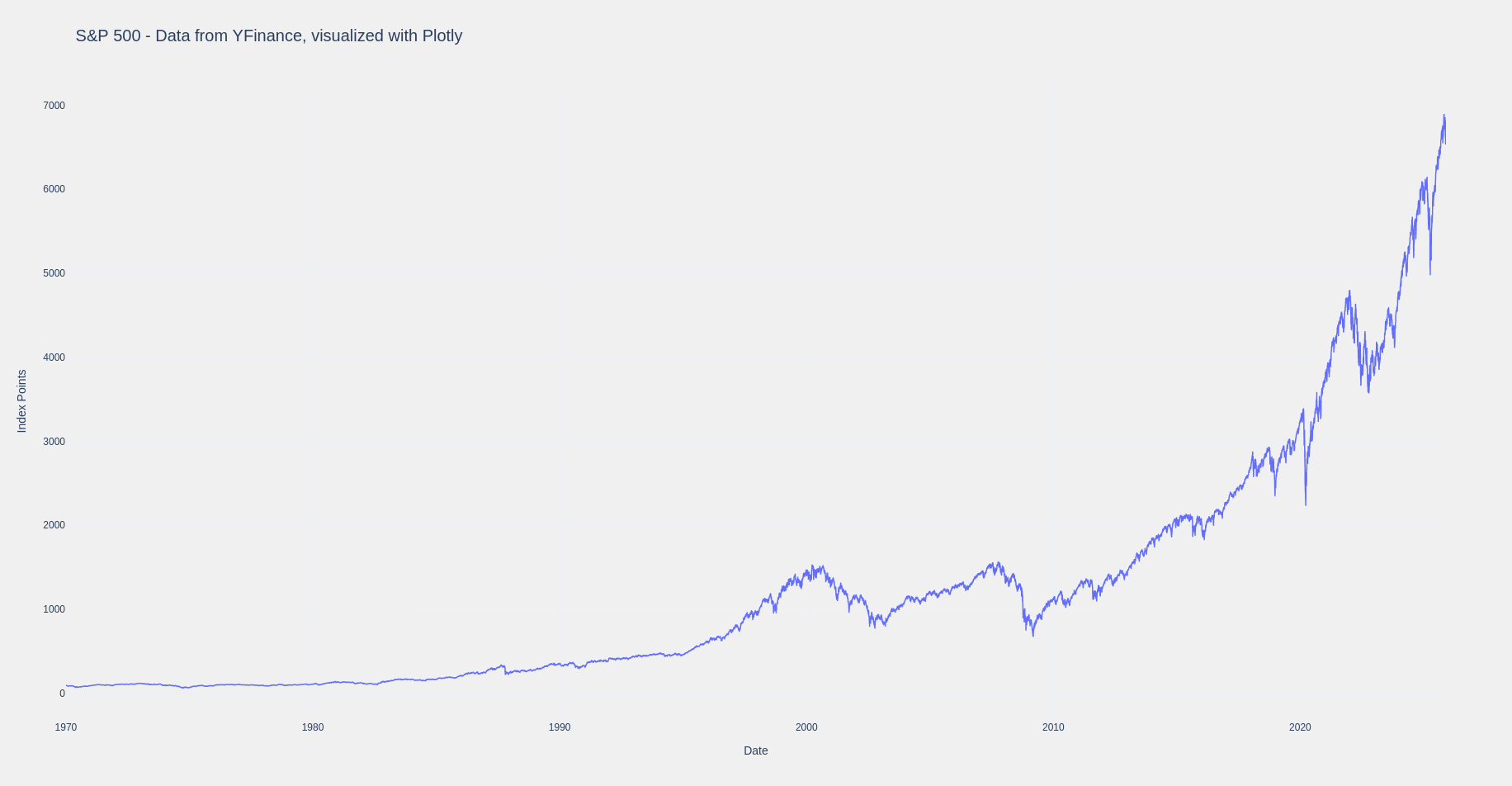
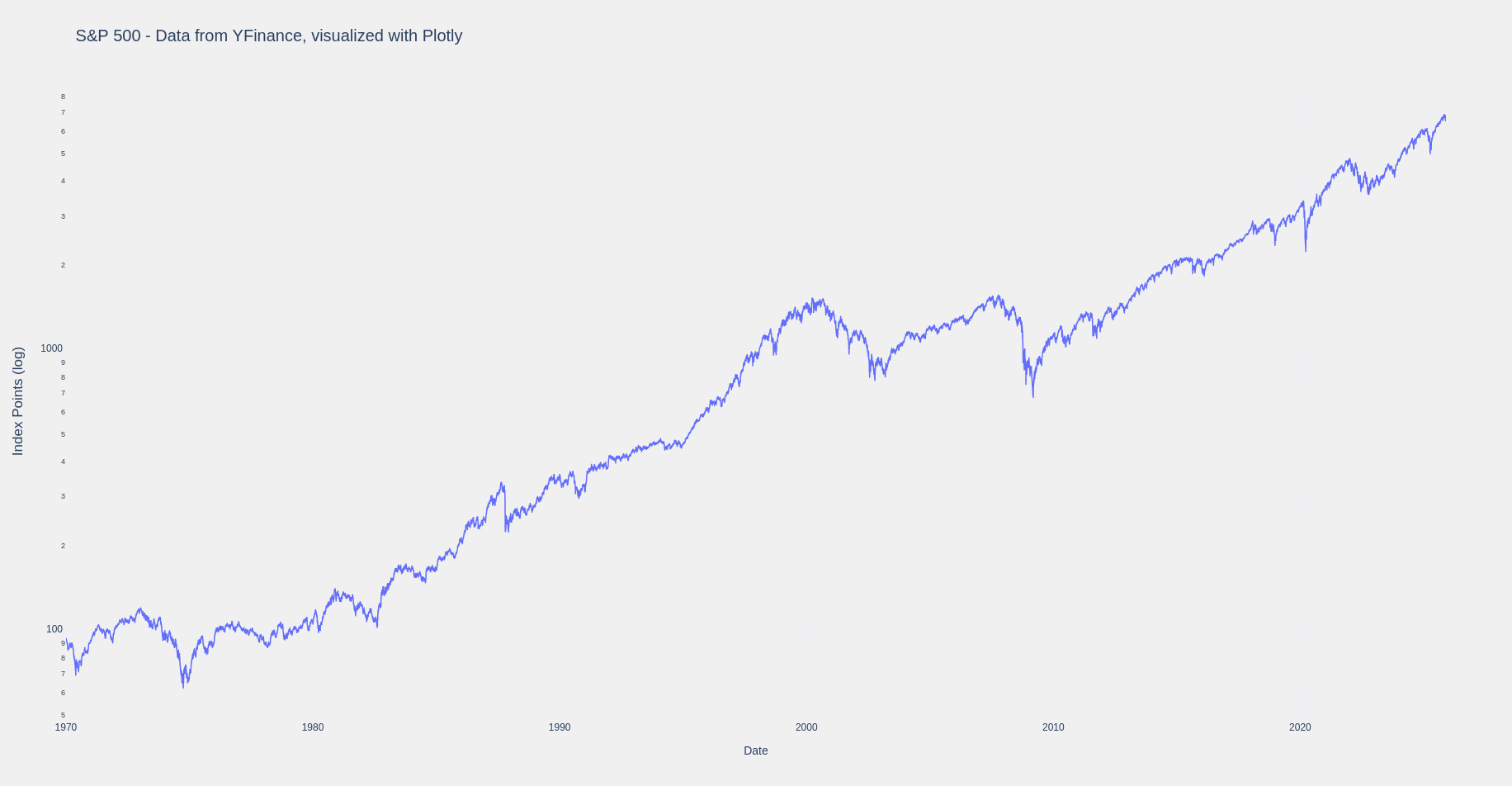
Since this is an exponential trend and humans have a hard time grasping it, here is the same data on a logarithmic scale. This view makes it easier to see the consistent growth rate over time.
Further reading
Some lessons I learned during my first five years of investing: My first 5 years in the stock market