
Looking at Duolingo as an investor
I have used Duolingo every day for years, long before I knew there was a ticker symbol behind the owl. When I realized that the company behind the famous language-learning app was public and listed on Nasdaq, the stock price and the overall market also felt overheated, so I decided to postpone any serious investing decision.
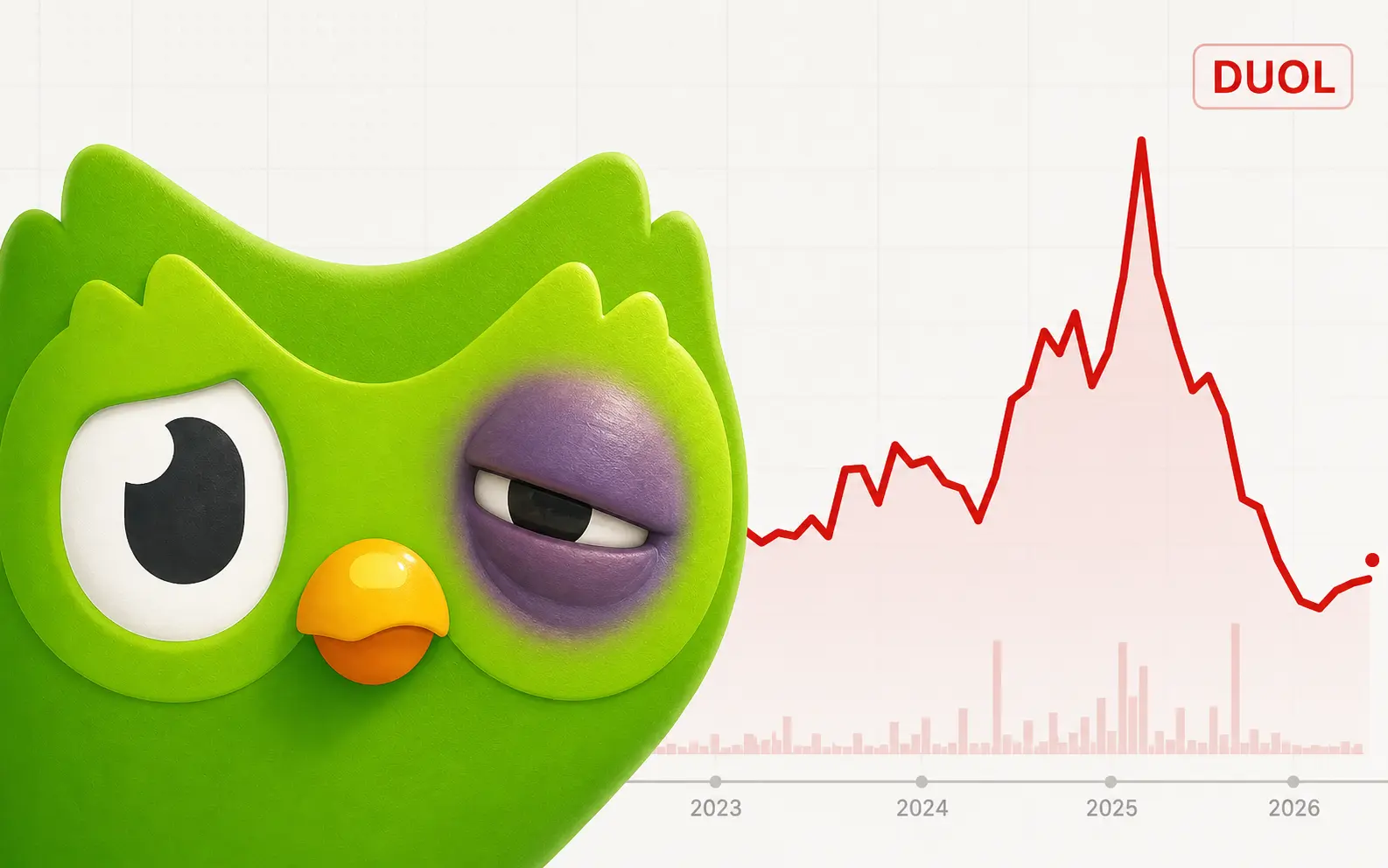
Over the last couple of months, I noticed that the share price was roughly 70 to 80% below its all-time highs, while the product I use every day kept getting better and better. I bought some shares before and after the Q1 earnings call, and I may pick up a few more if the upcoming earnings calls still align with my hypothesis.
This post is my attempt to write down the current situation around Duolingo as a company: is it just a language-learning app that can be easily disrupted by AI, or is it becoming an AI-native education platform driven by years of custom data collection?
Note: This is not investment advice. I do not share in your profits, nor am I liable for any losses. I am invested in the company.
Why the stock is under pressure
My gut feeling on Duolingo is very bullish, so I spent a lot of time trying to understand the bear case according to the available information on the internet. That way, I am trying to intentionally fight against my confirmation bias and not only let the positive scenarios sink in.
The fundamentals have not really changed and still look strong to me. The company is growing fast, with high free cash flow and basically no debt. Nevertheless, the market is probably repricing the company for the following reasons:
- AI apps are becoming good tutors: Generic tools like ChatGPT can already explain grammar, create exercises, and practice conversations. I tried using it for Portuguese and it works really well for short learning sessions.
- Real-time translation changes the motivation: Phones, earbuds, and AI assistants are making translation easier. People may feel less pressure to learn a language properly.
- Building apps is getting cheaper: More competitors can create learning products now. That does not mean they can instantly copy Duolingo, but it definitely lowers the barrier.
- AI features may increase costs: The new speaking exercises (Video Call with Lily) are obviously AI-driven. I cannot judge what the long-term impact on margins will be.
- Management is choosing long-term growth: The CEO has talked about prioritizing user growth and product quality over short-term monetization in the last earnings calls. I actually like that, but the stock market wants to see revenue and earnings growth.
Why I still find the business interesting
For me, this comes down to two questions. Will AI disrupt Duolingo, or will it make the product better? And is management really choosing long-term user growth over short-term monetization, or is that mostly a story to calm down nervous shareholders about weaker subscription growth?
I think no one can really know for sure yet. That is the point of watching the next quarters.
- AI is already inside the product: I want a company to have a clear AI strategy, integrate AI into the product, and eventually extract real value from it. Duolingo is clearly doing all of them. The company uses AI to create learning modules and to make users actively speak in conversations with different characters. To me, the product is getting better because of these AI-driven features.
- The brand is hard to copy: You cannot simply vibe code another learning app and get a user base like Duolingo. I dont know exact market-share numbers but Duolingo is way before it's best competitor Babble. This might be a winner-takes-most market, similar to what happened in streaming and music.
- The product is not only a gamified learning app: Duolingo has years of learning and behavior data from millions of users. It can test, measure, and improve the learning experience in a data-driven way at high speed.
- Duolingo is a habit: Talking to ChatGPT works well for a single practice session, but whenever I started doing it, I lost track a few days later. Duolingo is a habit product. At least for me, that works: I am now at a streak of 800+ days. This may still be my weakest argument, because many big companies know exactly how to increase engagement. The question is whether they can also make me learn new things, not just keep me scrolling.
- I like the long-term focus: If management really does prioritize product quality and daily active users over squeezing more money out of the current user base, I like that. AI could help Duolingo move closer to its mission of making high-quality education available to everyone. In that context, I will closely follow daily active user growth and the conversion from monthly active users (MAU) to daily active users (DAU) in upcoming earnings calls.
- A founder-led company: This is personal, but I like that Duolingo is founder-led. For companies with big missions, I prefer having someone in charge who is deeply motivated by the original idea.
The following image shows the growth of DAU and MAU over time. MAU and DAU seem to move in sync. For the future, I mainly care about DAU growth, because the image also shows that Duolingo is getting better at converting MAUs into daily active users.

What I want to watch next
At the time of writing, Duolingo's Q2 2026 earnings call is scheduled for August 5, 2026.
User growth: Is DAU growth still strong? Is the company still on track toward its mid-term goal of reaching 100 million daily active users?
AI value: Is AI improving engagement and speaking practice in general, and not only for me? Or is it mainly increasing costs?
New verticals: Are the new verticals (Math, music, and chess) growing with similar dynamics?
My thesis could be wrong if Duolingo's learning data is less valuable than I think. In that case AI disruption is a real risk.
I am looking forward to reading this in a couple of years and seeing if I was lucky or completely wrong.