
Spending money on the life I want
Our spending can reveal our priorities. But when we take a closer look, it often doesn't match what we would like it to be. Lately, I have often thought about the question: Are my expenses really aligned with my values and the life I want to have?
For me, this comes with two tasks. First, I need to write down what I would really like me to spend my money on. Second, I need to check from time to time whether my actual spending still moves in that direction and adjust if necessary.
Writing it down is the easy part, at least for me. Maybe because I have already thought about this for the last couple of years every now and then. Acting like I would like to act, checking honestly, and changing small habits is the harder part.
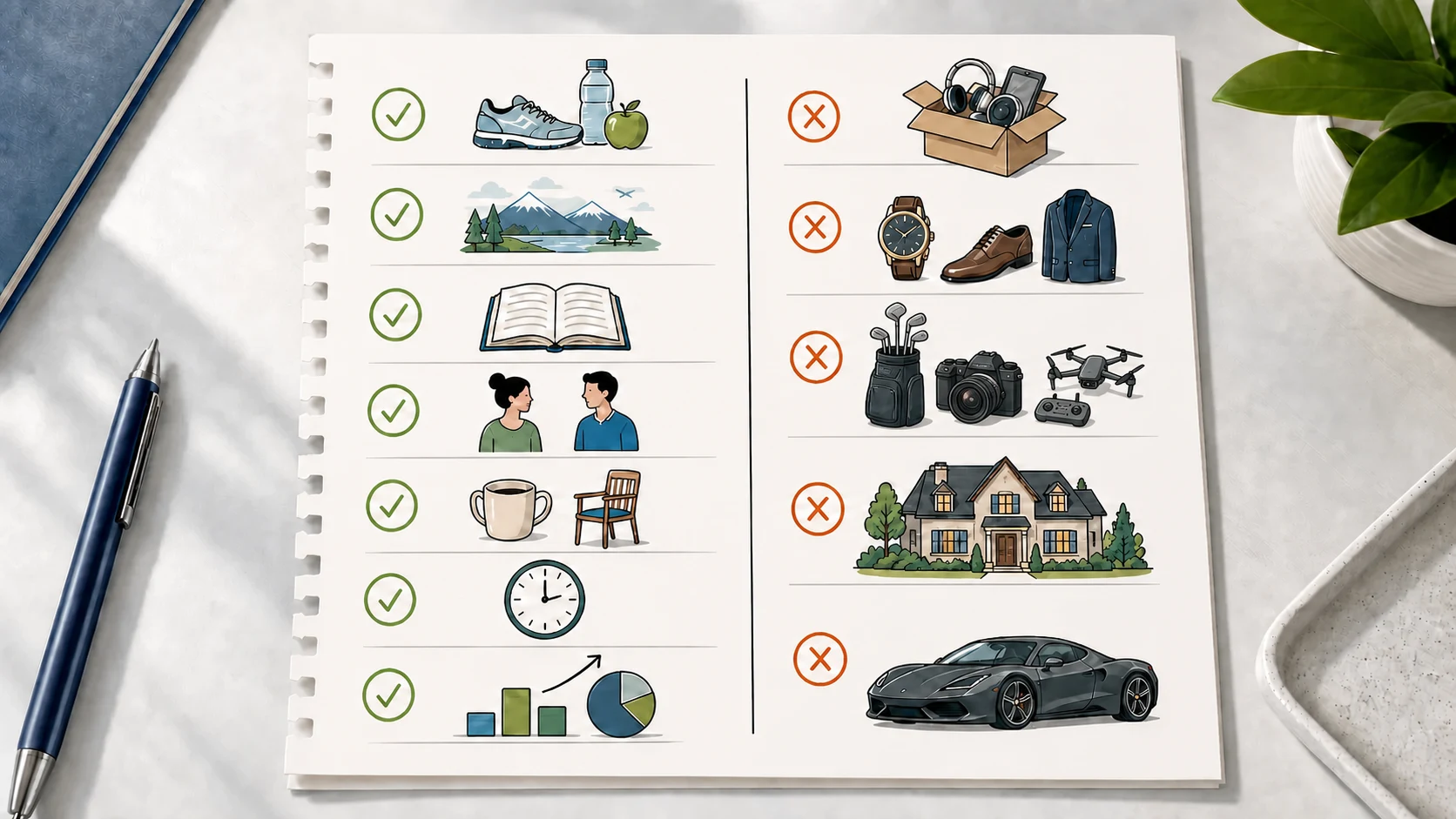
Below I list categories I like spending money on and categories I want to avoid. They help me decide future expenses. If something fits into the first group, it is probably worth spending money on. If it fits more into the second group, I would like to avoid it. Looking at these categories, they feel so damn obvious. Nevertheless, in reality, we often behave completely differently. Most of us probably do not pay much attention to this or clearly think through which expenses actually benefit our lives.
What I am happy to spend money on
Health: I think I already buy mostly healthy, unprocessed food, usually from the discounter. Nevertheless, I tend to buy cheap and do not always consider quality. Especially for meat, I would like to become someone who genuinely likes to spend more on good-quality meat. My favorite sports, running and lifting, are among the cheaper ones: a gym membership, some clothes, and each year a pair of proper running shoes. Events like a marathon can be indeed expensive, but if they keep me motivated and active, I would like not to care too much. What I want to improve is preventive health. I usually go to doctors only when there is a real need, but I would like to spend more on prevention when it makes sense.
Experiences: I am happy that I spent money on trips in the past, especially bigger trips outside Europe. They are great memories, and the earlier I do them, the longer I can enjoy looking back. I also benefit from new impressions, different ways of living, and new perspectives. Traveling is expensive, but right now I can afford it without a family to support. I care less about expensive accommodation and usually prefer an Airbnb with a kitchen over an all-inclusive hotel. Day to day, my normal leisure costs are low by nature. For the future, I want to stay simple in normal life but not be too cheap when a new experience feels worth it.
Learning: So far, my spending here is still quite low. Books do not cost much, although I have many of them and a few I have not read yet. If there are good Coursera or Udemy courses on a topic I care about, I usually buy them. I have not tried personal coaching or longer seminars yet. If there is a good one in the future, I do not want to block myself only because of the price. My life has benefited a lot from learning, and not only in the field I work in professionally.
Relationships: I already spend a lot of money on visiting family and friends and on of course for shared experiences, like events, traveling and so on. These are probably some of the best things money can support. The future part is generosity. I do not naturally tend to be very generous, but I would like to become more generous here, especially with meaningful gifts, invitations, and time together.
Quality: I naturally tend to buy cheap, so this is where I need to act against my first instinct. I don't care much about luxury brands, but if I like a pair of shoes, I do not want the difference between 70 and 120 euros to matter too much. I'll probably use them almost every day for a whole year. The same goes for a good pan, a good knife, or a good jacket. In the future, I want to do this more intentionally. Buying one good thing fits my minimalist direction better than buying several mediocre things.
Time: I am not an optimizer of every hour. I often buy the cheaper flight, even if the layover is longer. But what I already try to do is avoid things that cost me time later. Belongings can cost a lot of time. Things need maintenance. Before buying something, I want to think twice whether it really benefits my life. A big garden, for example, is probably not right for me if I do not like taking care of it on weekends.
Freedom: With the money I do not need for living, I buy future options. Stocks are probably where most of my excess money went over the last years, mostly because of the habit of paying myself first. I wrote more about that investing path in my first 5 years in the stock market. I like the idea of buying independence and future time more than buying things I do not really need today. Here I just want to continue the way I did the last couple of years.
What I try to spend less money on
Status purchases: Designer clothes or cars as status symbols do not motivate me much. Luckily, buying things to impress people feels uncomfortable for me. Moreover, the opportunity costs of flexing are just too high.
Lifestyle inflation: A higher salary does not automatically mean that every part of life needs to become more expensive. Maybe some of that is fine, but I want to notice it before it silently becomes the default. I try to keep my fixed costs low and cancel any subscription I do not really need. I like to pay for comfort to a point, but no luxury.
Impulse buys: They have been a big enemy, but I have them more or less under control. They definitely do not align with my minimalist mindset. To get a clear picture, I can just scroll through my Amazon order list from the last year and ask how much of it I really needed.
Identity purchases: Buying a 2,000-euro bike before actually cycling. Buying expensive camera gear before taking photos. Buying supplements before training consistently. I like the sentence: Become the person first. This is where I actively need to be careful, because I regularly catch new interests. Not every interest lasts very long.
Some categories are more emotional than rational for me: insurance, cars, kitchens, and furniture. I do not drive broken cars anymore, but I still have an older one I bought second-hand. My kitchen and furniture are functional, and I want to keep them that way.
Final thoughts
Since I am a very frugal person, the first section is mostly about allowing myself to spend money when it fits one of these categories. The second section, about what I want to avoid, is the tricky one. Writing them down was easy. Reading them, they feel obvious to avoid. The hard part is noticing them in reality. They often appear subtly and only become visible in retrospect. Getting at least some awareness is the first step toward improvement.